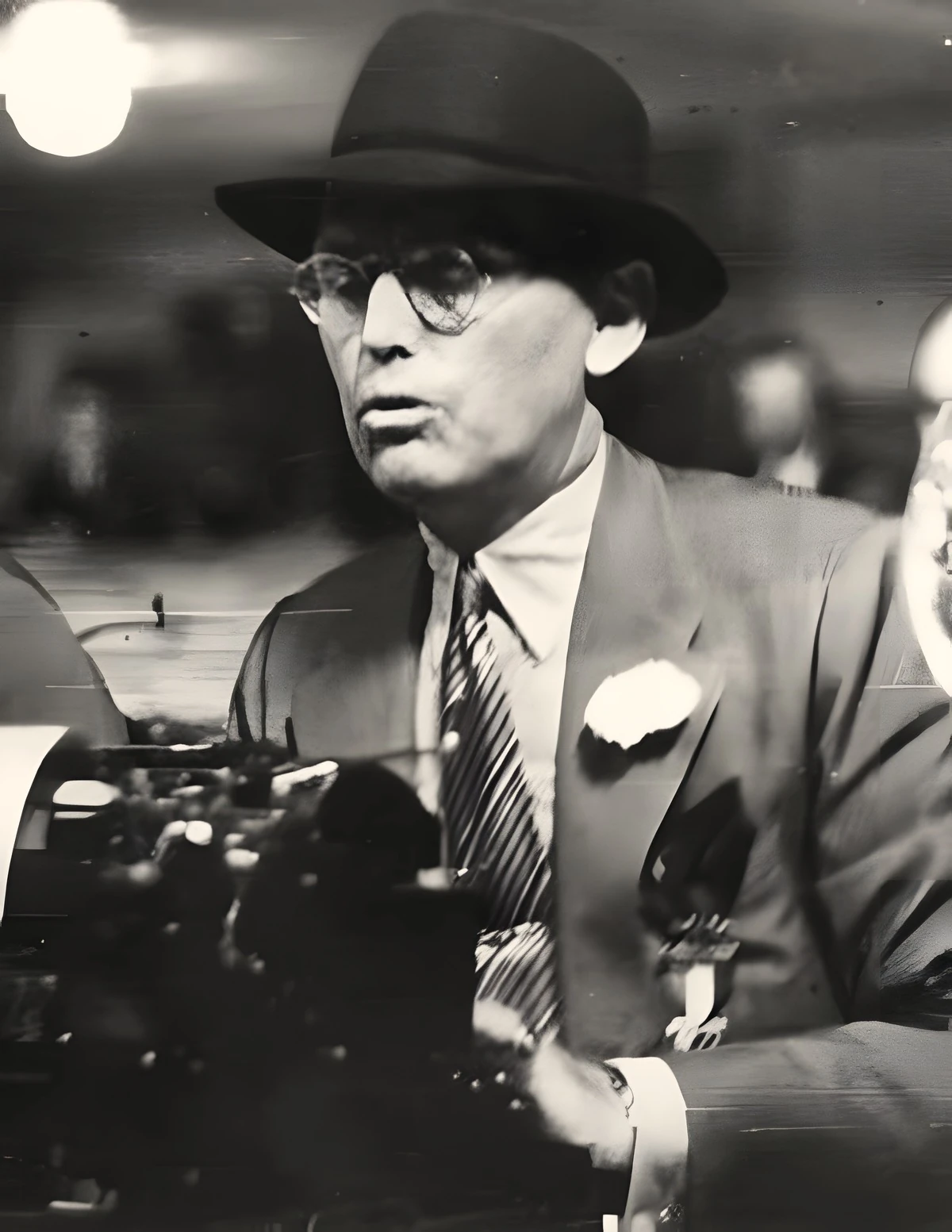
The Damon Runyon Theater
The World Broadway Took You Into
Damon Runyon spent decades writing about a very particular New York — a place populated by gamblers, showgirls, small-time hoods, and racetrack touts who spoke in a thick, present-tense vernacular all their own, almost always devoid of contractions. Runyon himself died on December 10, 1946, so when Alan Ladd's Mayfair Transcription Company — the same outfit behind Ladd's Box 13 — brought that world to radio in 1948, the series drew entirely on a closed catalog of published stories. Ladd, a longtime admirer of Runyon's syndicated column "The Brighter Side," conceived the project as a weekly anthology with his Mayfair partner Bernie Joslin. A gun wasn't a gun in this Manhattan — it was a "roscoe." The streets had a rose-tinged aura even when the stories turned dark.
The whole thing was built around a narrator named Broadway, who walked listeners through the crises and consolations of Runyon's "guys and dolls" week after week. John Brown played him in Brooklynese, and the character worked as an ideal guide — fitting, since the show acknowledged that "Broadway" was an alias, much as "Harry the Horse" and "Sorrowful Jones" were aliases in the fiction itself. Radio Life captured something essential about what made Runyon's people endearing: "Runyon mobsters are naive, easily hurt, and endowed with hearts of gold and the childlike whimsies of Margaret O'Brien." Dangerous on the surface, soft underneath — that was exactly what the series tried to get right.
How It Almost Wasn't Made
Pat O'Brien was originally signed to play Broadway, and newspaper accounts pointed to a New York recording session for all 52 episodes in the summer of 1948. An audition recording titled "Princess O'Hara" survives, with O'Brien and Wendy Barrie heard pitching the next installment. Then Howard Hughes ordered reshoots on RKO's The Boy with Green Hair to strip the film's social-intolerance message, holding O'Brien through September 1948. Estimates suggest he may have cut as many as five episodes — two to five per session was the industry standard — before being called back to the coast.
Compounding the trouble, James Caesar Petrillo's American Federation of Musicians recording ban was in force for most of 1948, lifting only on November 22. That's why the same theme music turns up on both the surviving O'Brien audition and the final production pressings — there was no opportunity to record fresh underscore. The series finally surfaced on independent station KSEL in Lubbock, Texas, before reaching KFI in Los Angeles on January 11, 1949, WOR in New York the following year, KGO in San Francisco, and eventually a Mutual network run from 1951 to 1952.
The Cast Behind the Characters
For a syndicated production, the series drew serious talent. Gerald Mohr played Sorrowful Jones, William Conrad played Dave the Dude, Alan Reed played Little Mitzi, Herb Vigran played Harry the Horse, and Anne Whitfield played Little Miss Marker. The supporting roster read like a call sheet from Hollywood's radio community — Frank Lovejoy, Sheldon Leonard, Hans Conried, Ed Begley, Jeff Chandler, Willard Waterman, Parley Baer, Luis Van Rooten, Eddie Marr, Sam Edwards, Joe Du Vai, Lionel Stander, Sidney Miller, Olive Deering, and Joe De Santis among them. The characterizations delivered by veteran dialecticians like Mohr, Vigran, Leonard, Van Rooten, Reed, and Stander were widely noted as "imitated in both Radio and Television for decades to come."
John Brown was an unlikely fit on paper — a British-American character actor born in Hull, Yorkshire, who'd made his Broadway debut in a 1931 production of Six Characters in Search of an Author. By the time he took on the narrator role, he was already playing Al, Irma's small-scale hustler boyfriend, on My Friend Irma, plus Digger O'Dell the friendly undertaker on The Life of Riley, Thorny on The Adventures of Ozzie and Harriet, and Homer Willoughby on A Day in the Life of Dennis Day. Multiple sources call Broadway his most memorable role, and it was always noted as a measure of his talent that this quintessentially American character was portrayed by an Englishman. Brown's career later collapsed after he refused to answer HUAC's questions about Communist Party affiliations; he was named in Red Channels, faced a deportation order still under appeal, and died of a heart attack in West Hollywood in May 1957 at fifty-three.
Behind the microphone were producer Vern Carstensen, director Richard Sanville, and writer Russell Hughes, who kept each half-hour tight and tonally varied. The show's range was deliberately broad — comedy one week, outright tragedy the next. "For a Pal" was singled out as a particularly poignant example of what the series could do when it leaned into the sadder end of Runyon's register.
The Stories It Told
The source material gave the series plenty to work with. Notable adaptations included "Butch Minds the Baby," "Hold 'Em, Yale," "Baseball Hattie," and "All Horseplayers Die Broke" — stories that ranged from comic capers to hard-luck portraits. At the time the series was produced, the bulk of Runyon's fiction had gone largely untapped by radio, despite scattered earlier appearances on The Columbia Workshop, The Harold Lloyd Comedy Theatre, The Radio Reader's Digest, and The Screen Guild Theatre. Hughes had a deep catalog to draw from rather than retreading familiar ground.
Because the show was syndicated rather than tied to a single network, it continued selling into the mid-1950s, giving Runyon's Manhattan an unusually long afterlife. A CBS television version followed in April 1955, hosted by Donald Woods — a Screen Gems production sponsored by Budweiser, running 39 episodes through February 1956 with repeats into that June. Russell Hughes carried over from the radio scripts to write at least some of the teleplays, keeping a thread of continuity between the two versions of a Manhattan that, fittingly, had never quite existed anywhere except on the page.